
Thursday (6/10/2022), the Lecturer Team of Research and Community Service Lecturers of the Faculty of Pharmacy, University of Indonesia (UI) consisting of apt. Tri Wahyuni, M.Biomed., Ph.D., Prof. Dr. apt. Anton Bahtiar, M.Biomed., Dr. apt. Iskandarsyah, M.Si., apt. Delly Ramadon, M.Farm. Ph.D., and apt. Erny Sagita, M.Farm., Ph.D. who have expertise in the field of pharmacology and pharmaceuticals collaborated with the Plampangrejo Village, Banyuwangi in inviting the community to better understand the types of diseases that can appear in a person.

The FFUI Community Service Team and the Plampangrejo Village in implementing outreach activities on degenerative and non-degenerative diseases (Source: Documentation of the UI Faculty of Pharmacy Community Service Team)
As a person ages, bodily functions decline. This can lead to degenerative diseases, such as diabetes mellitus (elevated blood sugar levels) and hypertension (elevated blood pressure). Degenerative diseases are non-communicable because they are influenced by lifestyle habits, particularly diet. However, there are diseases that appear but are not related to aging. These are called non-degenerative diseases, which can be transmitted through physical activity that causes fluid exchange within the body.
The FFUI Community Service Team explained that a healthy lifestyle, including a more careful diet, can prevent or minimize the emergence of degenerative diseases. In her presentation, apt. Tri Wahyuni stated that with the development of technology, degenerative diseases can begin to emerge in young adults. This can be caused, among other things, by unhealthy food consumption patterns related to excessive consumption of sugar, salt, and oil. Therefore, it is necessary to raise public awareness regarding how to consume these ingredients properly and within a healthy range.
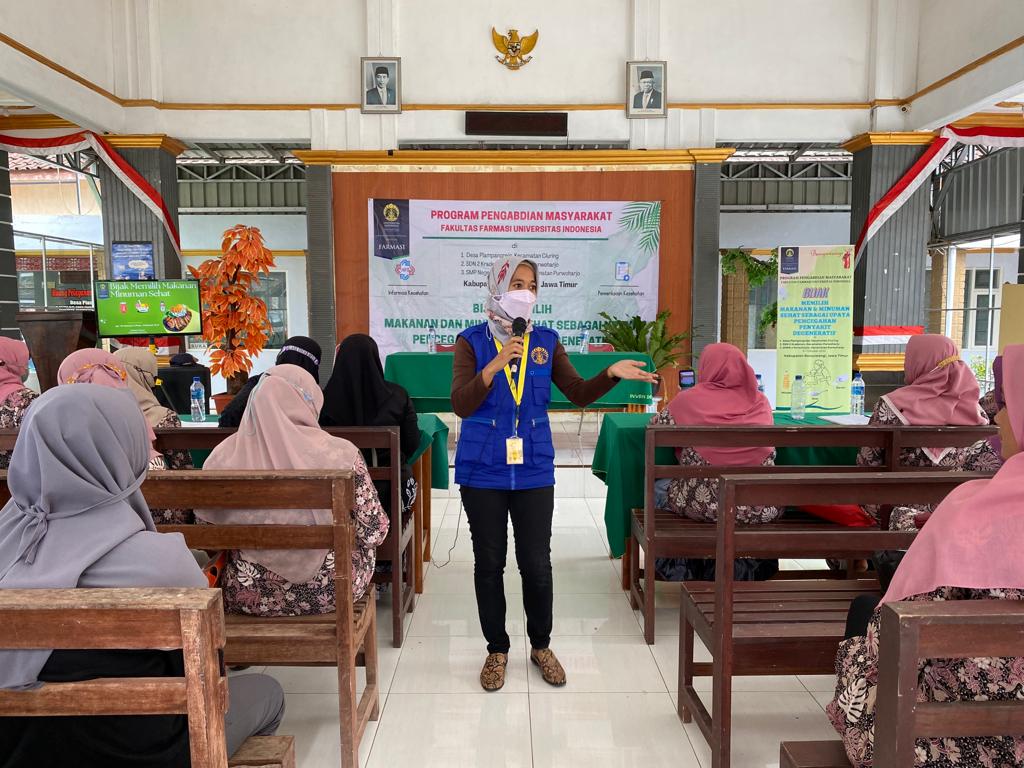

Counseling by apt. Tri Wahyuni regarding degenerative and non-degenerative diseases in the Plampangrejo Village community (Source: Documentation of the UI Faculty of Pharmacy Community Service Team)
As one of the independent villages in Banyuwangi Regency, Plampangrejo Village has a health week program that focuses on the introduction of non-degenerative diseases, namely HIV/AIDS. Yudi Wiyono, the Village Head of Plampangrejo, explained that although there is no data on residents infected with HIV/AIDS, this awareness campaign is necessary to prevent the spread of the disease in Plampangrejo Village and surrounding villages.
In addition to providing education on degenerative and non-degenerative diseases, the FFUI Community Service Team also conducted free health checks, measuring blood pressure, random blood glucose levels, total cholesterol, and uric acid levels. These health checks provided information on the health demographics of the Plampangrejo Village community, helping them become more aware of their own health.
From the results of the health check, it was found that 32% of the people of Plampangrejo Village had blood pressure above 120/80 mgHg, 14% of the people had random sugar levels above 140 mg/dL, 60% of the people had total cholesterol levels above 200 mg/dL, and 70% of the people had uric acid levels above 6-7 mg/dL. "This health check shows that the biggest health problems in Plampangrejo Village are hypercholesterolemia and hyperuricemia," said apt. Tri Wahyuni. Hypercholesterolemia is one of the triggering factors for heart disease and stroke. This is in line with information obtained from data from the Plampangrejo Village Health Center that in recent years, there has been an increase in the number of patients with heart disease and stroke.


Health check activities for blood pressure, random blood sugar, total cholesterol, and uric acid (Source: Documentation of the UI Faculty of Pharmacy Community Service Team)
Recommended measures following this health check include providing information on preventative measures that can be implemented by residents of Plampangrejo Village. One approach is to educate them about daily sugar, salt, and oil consumption limits. With this FFUI Community Service, it is hoped that the community will understand how to prevent degenerative and non-degenerative diseases that arise in the community.

FFUI Community Service Implementation Team, Local Community Service Team, Plampangrejo Village Officials, and Plampangrejo Village PKK Members (Source: Documentation of the UI Faculty of Pharmacy Community Service Team)